
H2 Physics
H2 Physics — 2019 Paper 2 (demo)
Feedback pinned onto the pages the student wrote. Scan the QR (or open the link) for a sample Cherlock clarification chat.

 Studyszn QuickMark
Demo Student feedback
Score: 50 / 80
General feedback
You scored 50/80 on this Paper 2.
By question: Q1 6/9, Q2 8/13, Q3 10/11, Q4 6/12, Q5 5/11, Q6 15/24.
Strengths: Q1(a)/(b) equilibrium and tensions are clean (, ). Q3 is strong overall (potential definition, , acceleration). Q2(b)(iii) Malus graph and Q2(c) time-base are good. Q6(c)/(d)(i) photon and mass-defect calculations are solid.
Next steps:
- Q1(c): take moments about the base (support cable about ; is the given wire tension).
- Q2(b): apply Malus twice with ; about and amplitude ratio about .
- Q4(a)(ii): use proton mass (not electron mass). Q4(b) was left blank.
- Q5(b): open-circuit and about ; terminal pd falls when the NTC warms.
- Q6(b)(i): multiply fractional change by . Finish Q6(d)(ii) intensity. For Q6(f), use low vibration / vacuum / dust advantages.
Mark summary
50 / 80
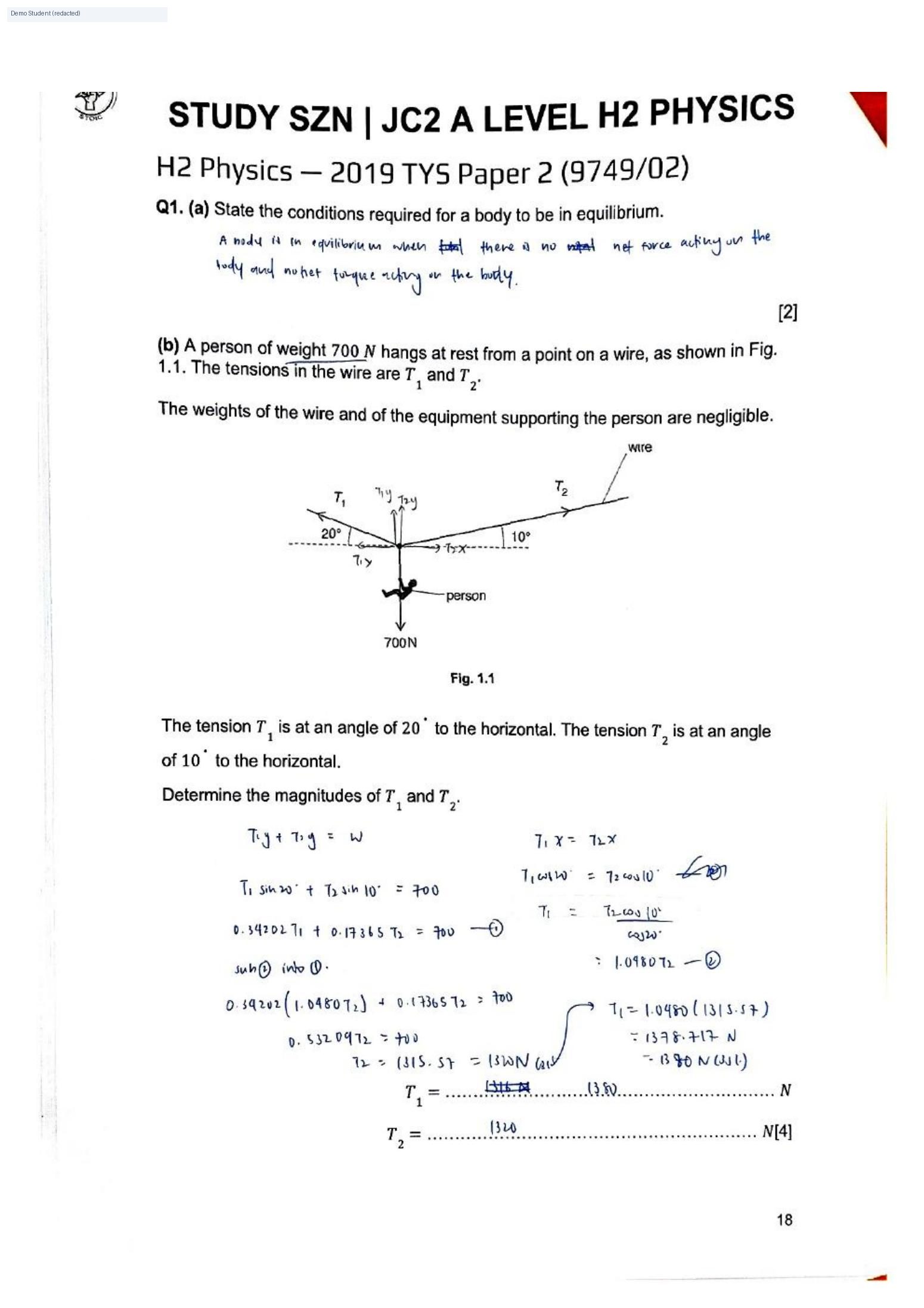
Q1(c) T value
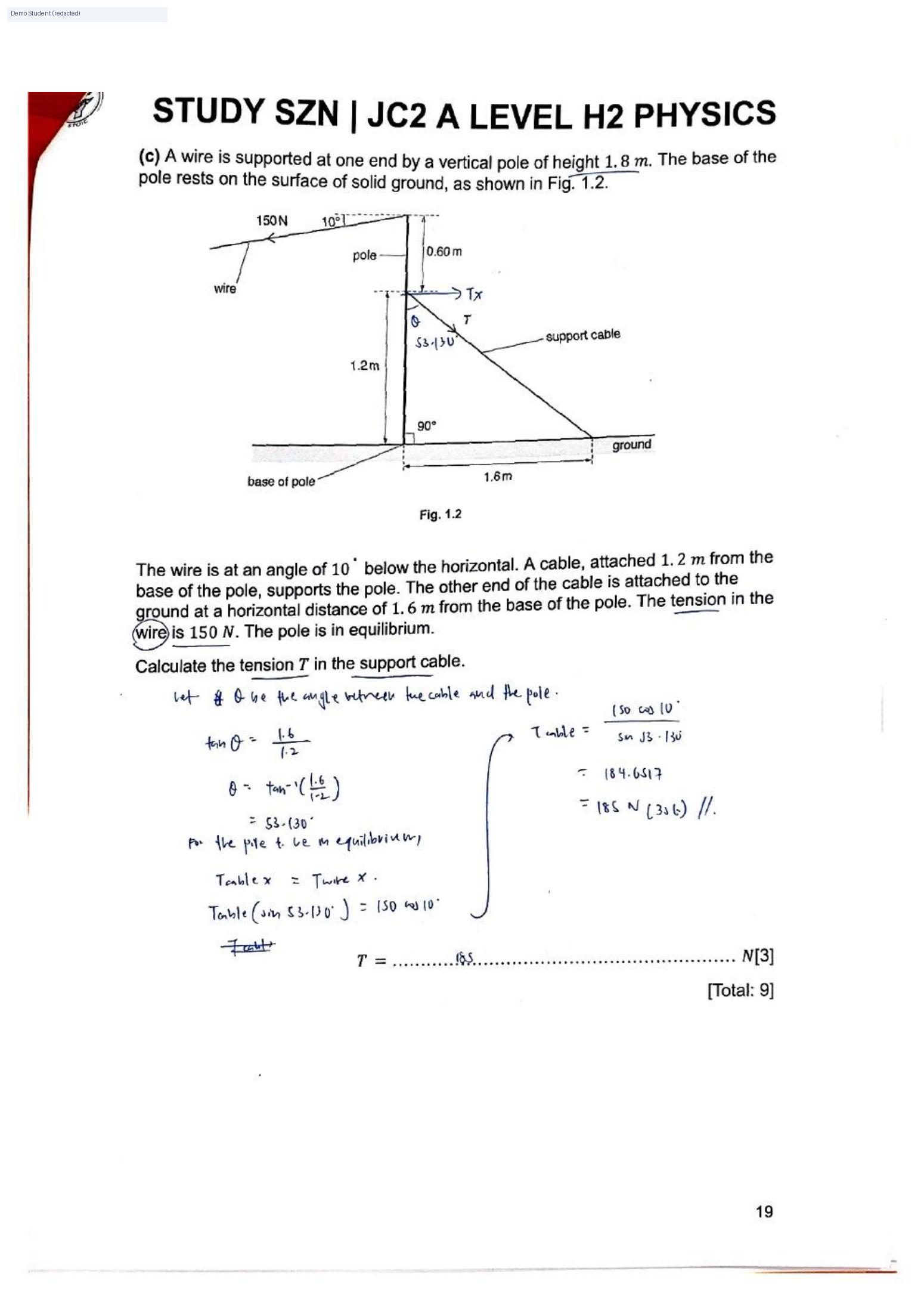
Your T = 185 N is too low. With moments about the base, T is about 277 to 280 N. Note: 150 N is the given wire tension, not the support-cable answer.
What to do next: Redo with moments about the base; expect T around 280 N (2 s.f.).
Q1(c) need moments
You balanced horizontal forces. Take moments about the base of the pole instead.
What to do next: Pivot at the base so the ground reaction has zero moment, then equate moments of the wire and cable.
Q1(c) wrong equation
This force-balance equation is not the moment equation about the base.
What to do next: Moment of wire: 150 cos10 x 1.8. Moment of cable: T cos(theta to vertical) x 1.2, or use horizontal components with heights as levers.
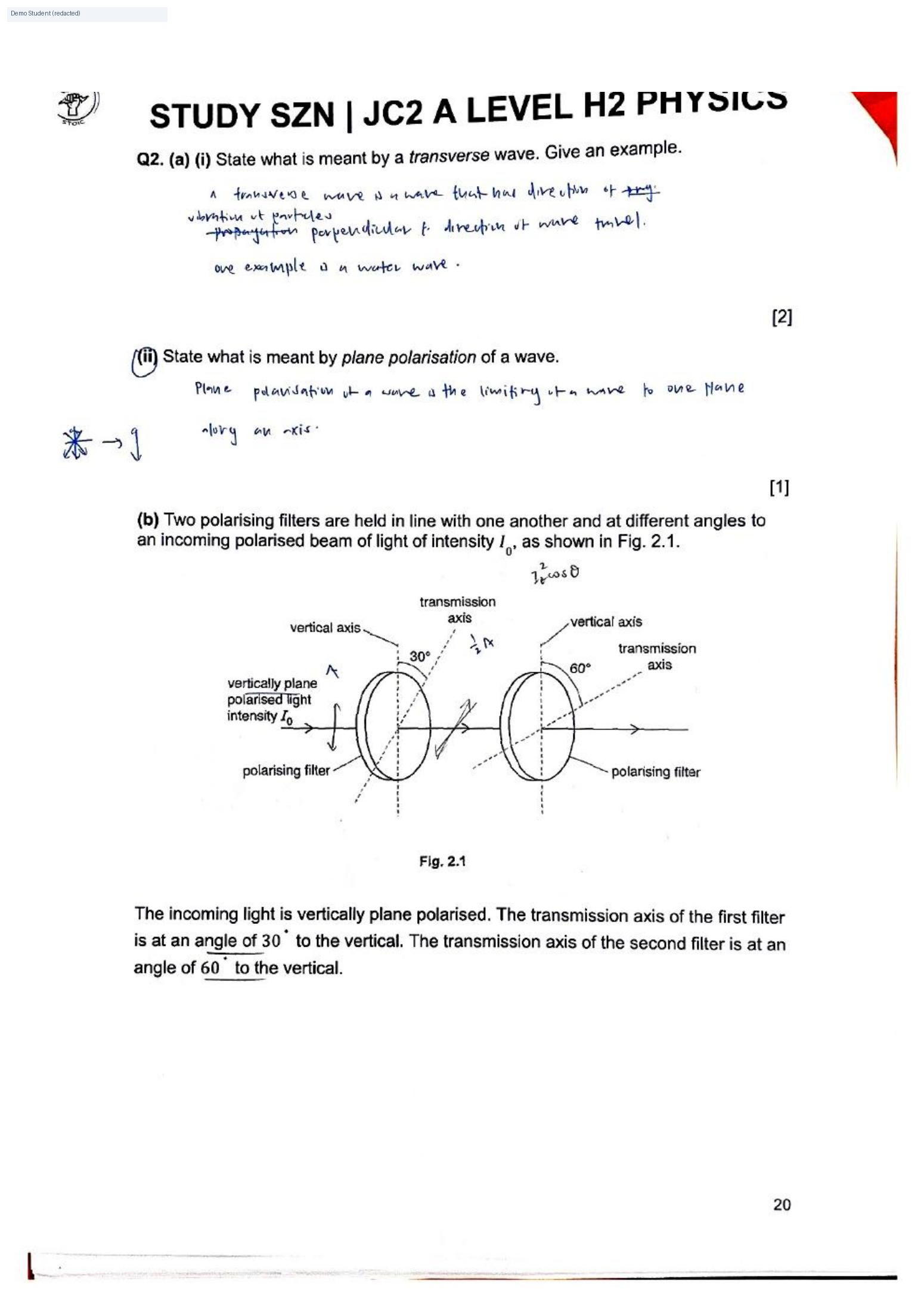
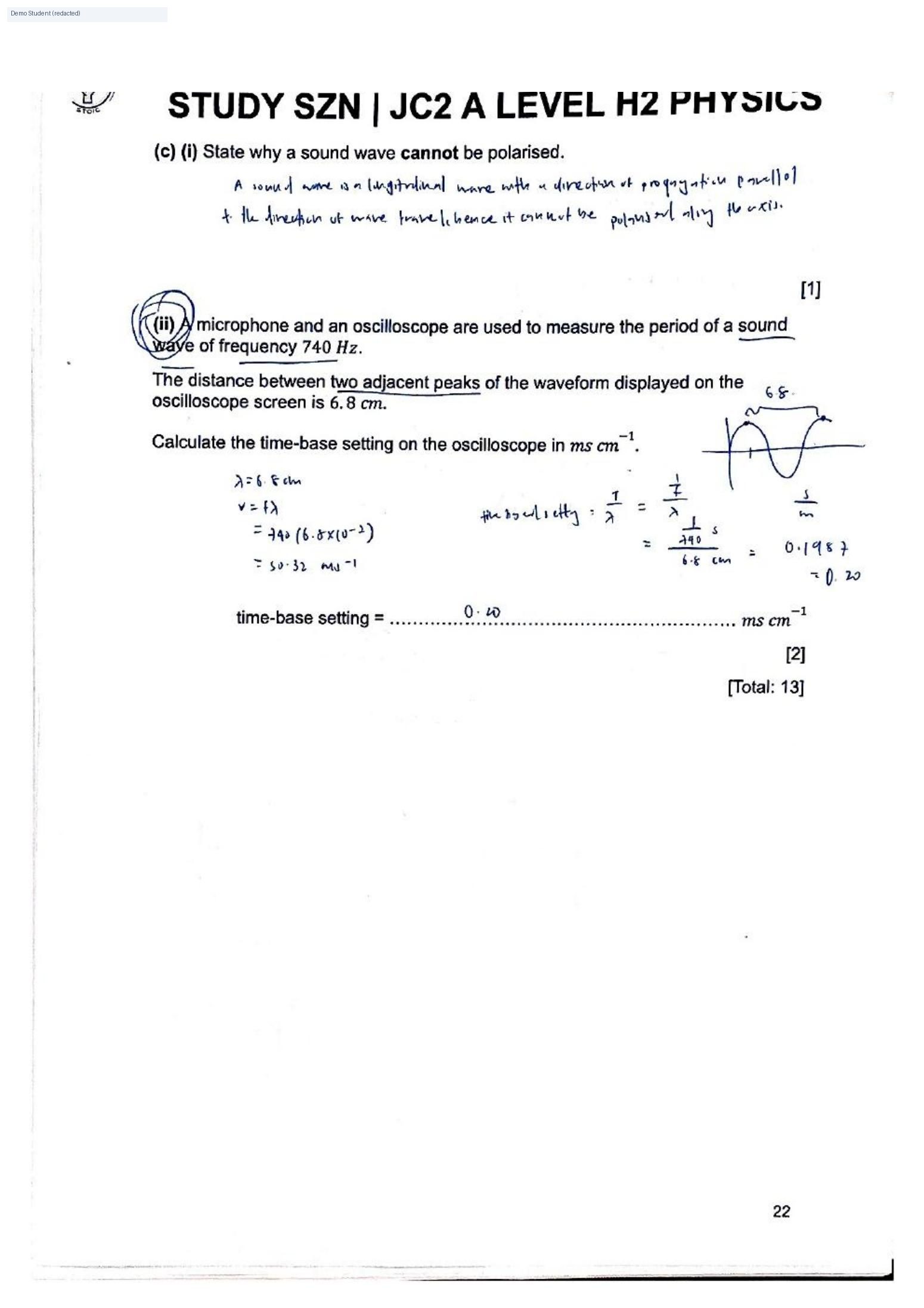
Q2(a)(i) definition
Correct. Oscillations are perpendicular to the direction of wave travel.
vibration of particles perpendicular to direction of wave travel
Q2(a)(i) example
Accepted. Water waves are a valid transverse example.
water wave
Q2(a)(ii) polarisation
Correct idea: oscillations limited to one plane.
limiting of a wave to one plane
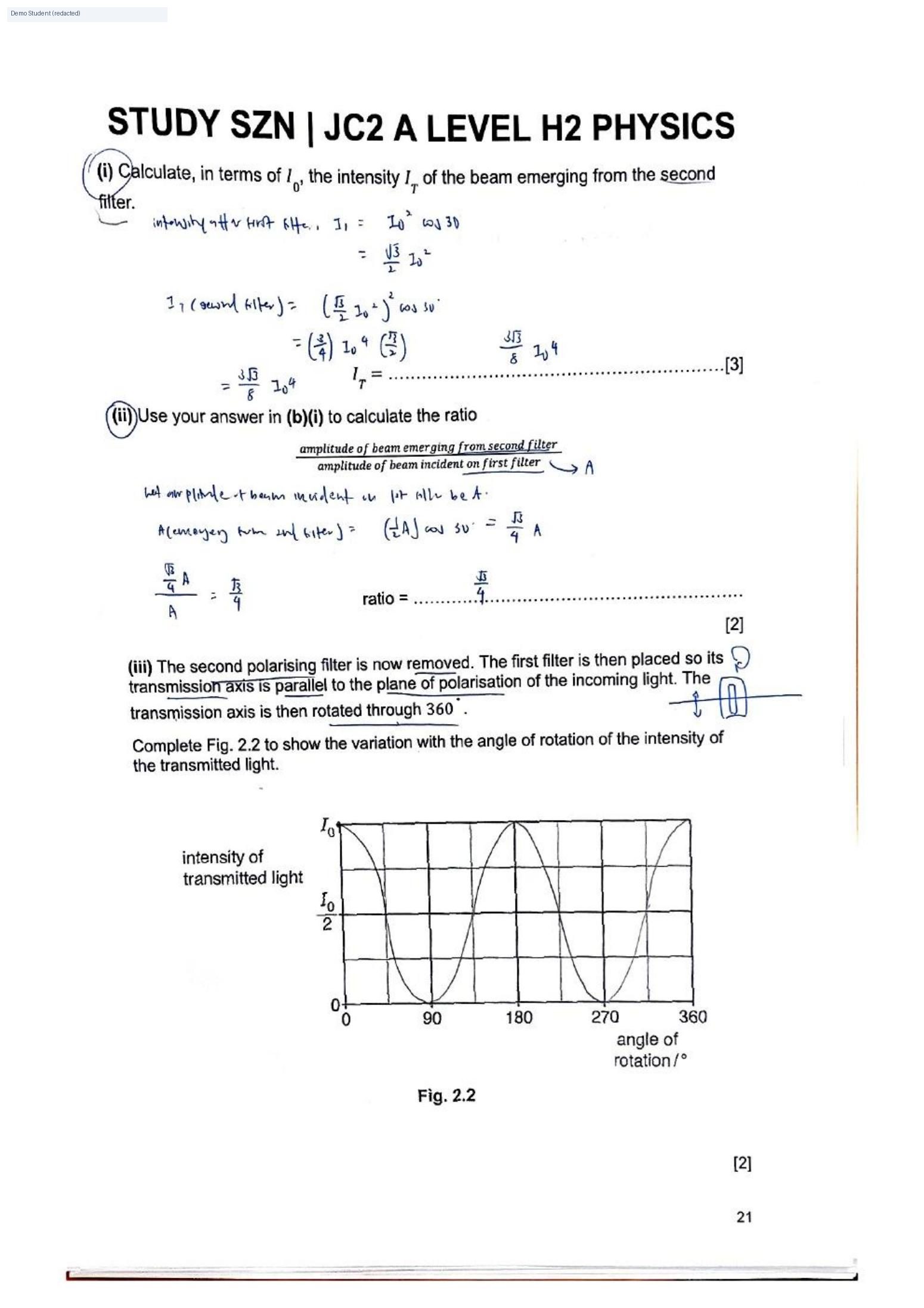
Q2(b)(i) Malus 1
Malus law is , not . After the first filter use .
What to do next:
Q2(b)(i) filter angle
The angle between the two transmission axes is 30 degrees (60 minus 30), not another 30 to the vertical alone.
second filter …
What to do next:
Q2(b)(i) IT
should be about (or ), not a power of .
What to do next:
Q2(b)(ii) setup
Use intensity proportional to amplitude squared: amplitude ratio .
What to do next:
Q2(b)(ii) ratio
Your ratio is too small. The correct amplitude ratio is about .
What to do next:
Q2(b)(iii) maxima
Correct. Intensity maxima at , and at .
Q2(b)(iii) zeros
Correct. Intensity is zero at 90 and 270 degrees.
zeros at 90 and 270
Q3(a) definition
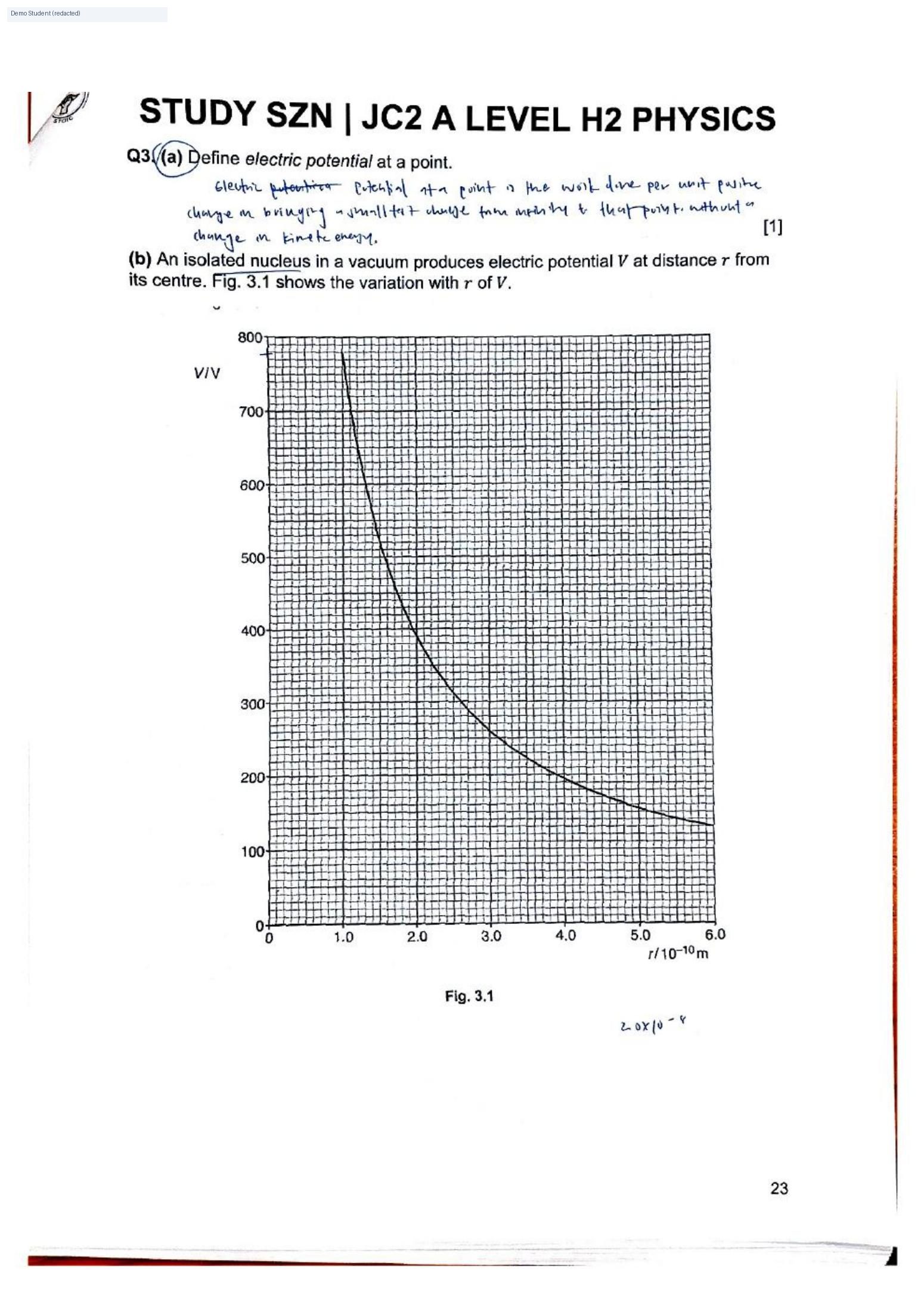
Correct. Work done per unit positive charge from infinity to the point.
work done per unit positive charge ... from infinity
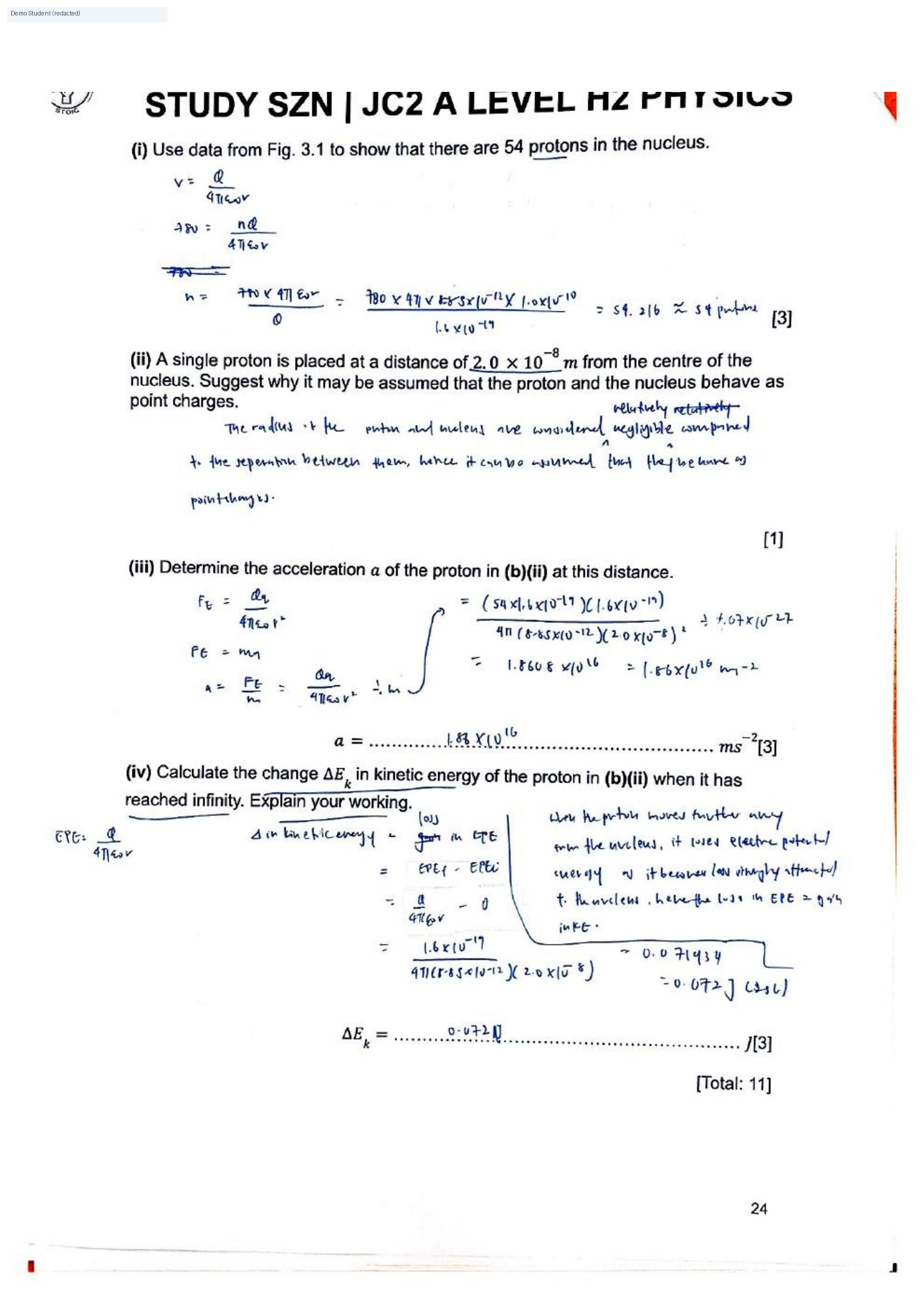
Q3(b)(i) V formula
Correct potential formula.
Q3(b)(i) Z=54
Correct. You showed there are 54 protons.
54 protons
Q3(b)(i) data
Correct. You used a point from the graph ( at ).
Q3(b)(ii) point charges
Correct. Sizes are negligible compared with the separation.
radius ... negligible compared to the separation
Q3(b)(iii) force
Correct use of Coulomb force.
Q3(b)(iii) value
Correct. .
Q3(b)(iii) a=F/m
Correct. Acceleration from a = F/m.
Q3(b)(iv) conservation
Correct. Gain in kinetic energy equals loss in electric potential energy.
loss in EPE gain in KE
Q3(b)(iv) zero at infinity
Correct. Electric potential energy at infinity is zero.
Q3(b)(iv) value
0.072 J is far too large. You need , which is about .
0.072 J
What to do next:
Q4(a)(iii) path
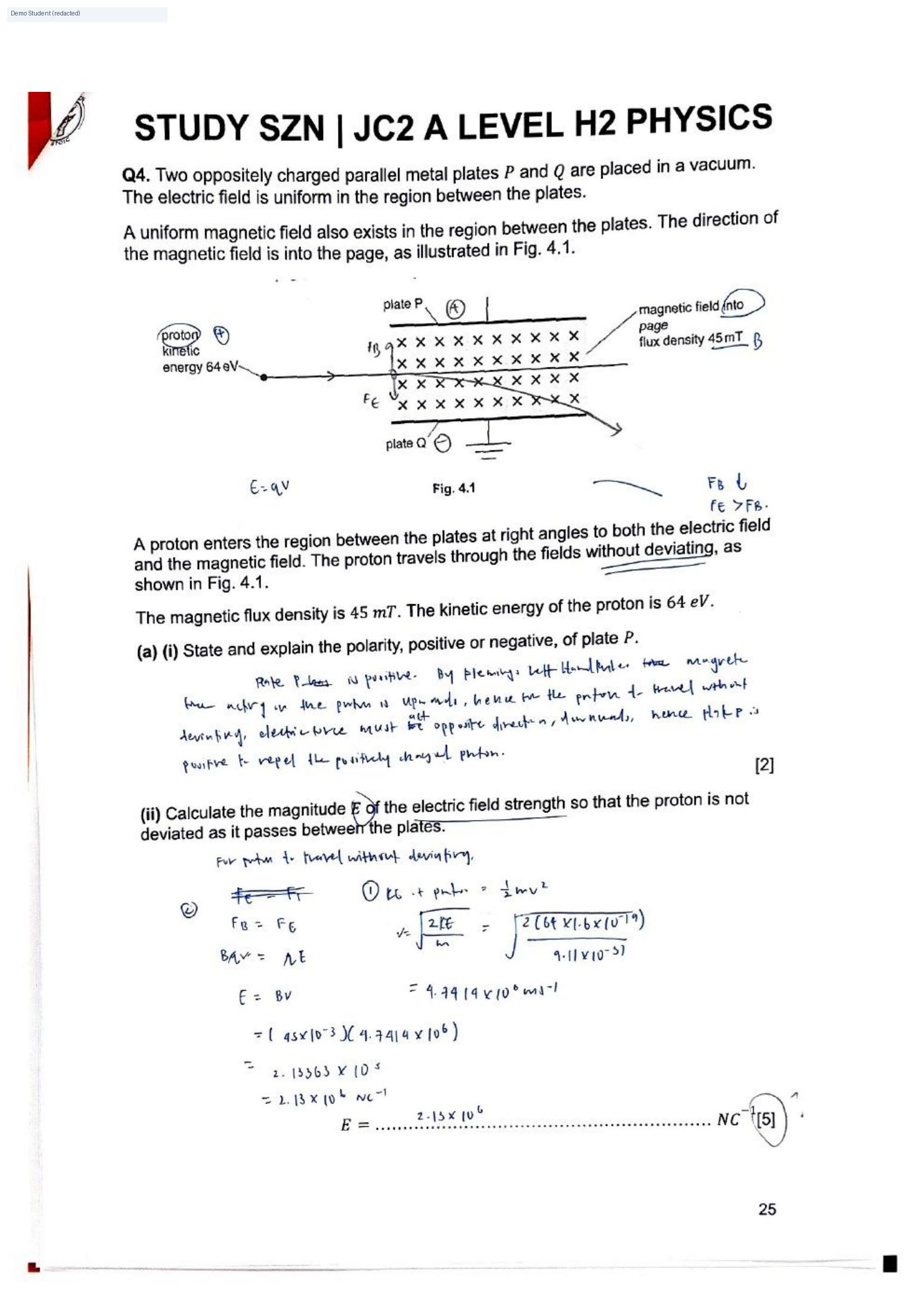
Correct. The slower proton curves downward toward plate Q.
curved path toward Q
Q4(a)(i) Fm
Correct. By Fleming's left-hand rule, the magnetic force on the proton is upwards.
magnetic force ... upwards
Q4(a)(i) polarity
Correct. Plate P is positive so the electric force is downwards.
Plate P is positive
Q4(a)(ii) eV to J
Correct. You converted 64 eV using .
Q4(a)(ii) v setup
Correct approach: find v from kinetic energy.
Q4(a)(ii) wrong mass
You used the electron mass . For a proton use about .
What to do next: Recalculate v with proton mass; v is about 1.11 x 10^5 m s^-1.
Q4(a)(ii) equate
Correct. You equated Bqv = qE so E = Bv.
Q4(a)(ii) E value
Your E is too large because v was wrong. With the proton mass, is about .
What to do next: E = Bv with the corrected proton speed.
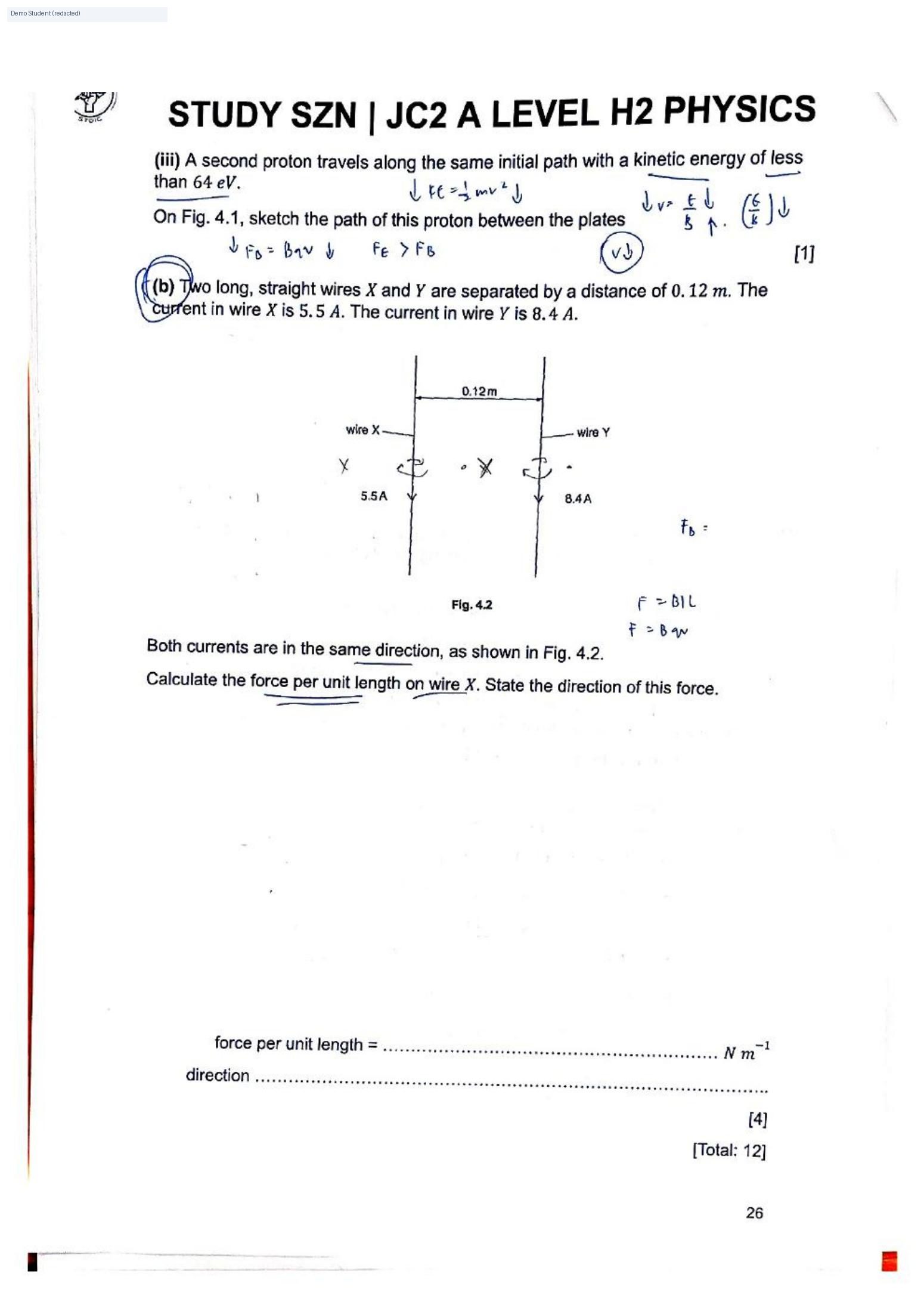
Q4(b) F/L formula
You need F/L = (mu0 IX IY)/(2 pi d).
only
What to do next: Combine B and F = BIL to get force per unit length.
Q4(b) blank B
No working for the field due to wire Y at X.
blank
What to do next:
Q4(b) numerical
No numerical answer. is about .
blank answer line
What to do next:
Q4(b) direction
Direction is blank. Parallel currents attract, so the force on X is toward Y (to the right).
blank direction
What to do next: State toward wire Y / to the right.
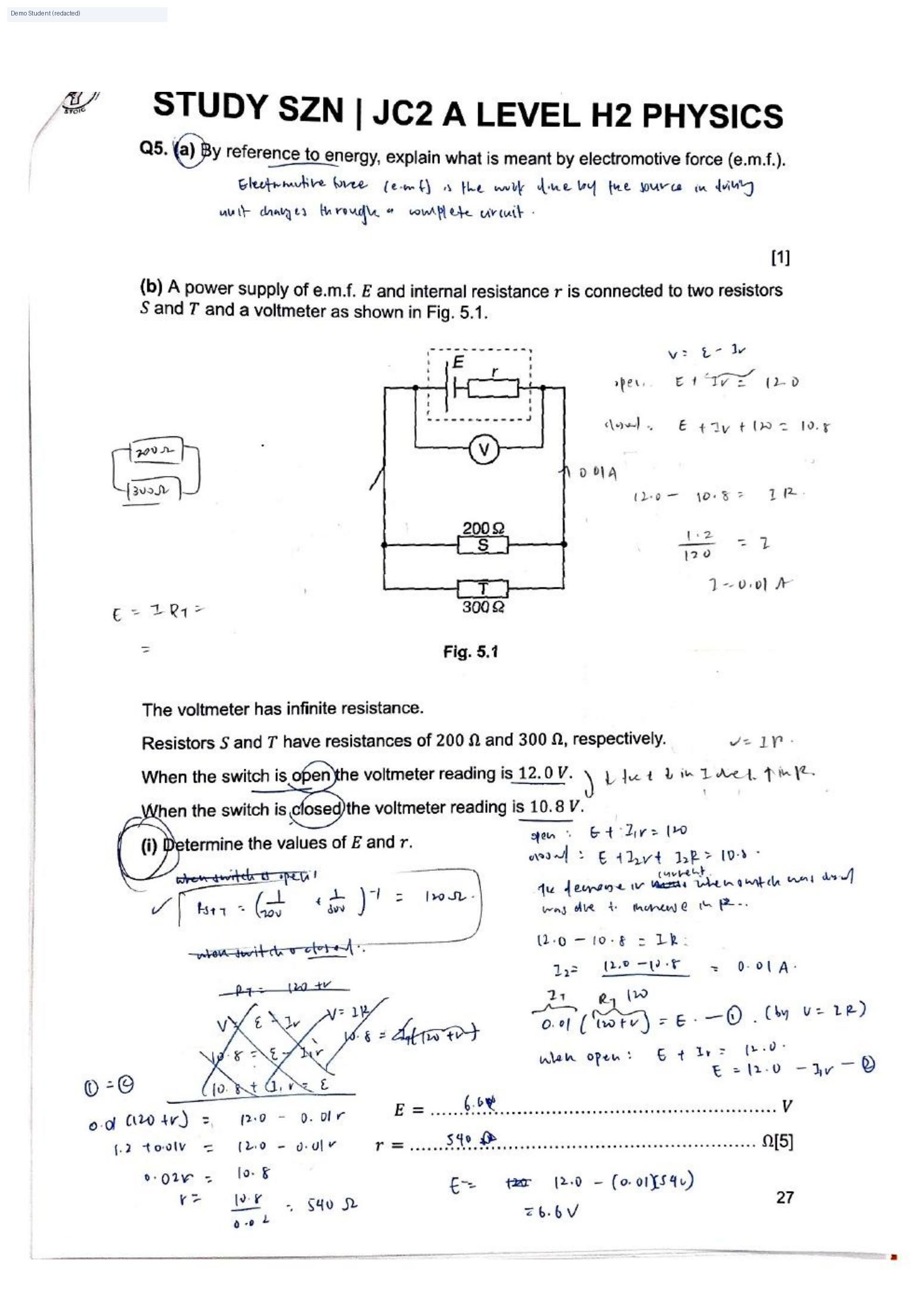
Q5(a) emf
Correct idea: work done by the source per unit charge round a complete circuit.
work done by the source in driving unit charges
Q5(b)(i) Req
Correct. S and T in parallel give .
120
Q5(b)(i) open circuit
Good. You recognised that when the switch is open, E = 12.0 V.
Q5(b)(i) E
When the switch is open the voltmeter reads the emf, so E = 12.0 V, not 6.6 V.
What to do next:
Q5(b)(i) answers
Both final values on the answer lines are incorrect (need and about ).
What to do next: Rewrite the answer lines with the corrected pair.
Q5(b)(i) r
is wrong. Use the potential divider: , giving about .
What to do next:
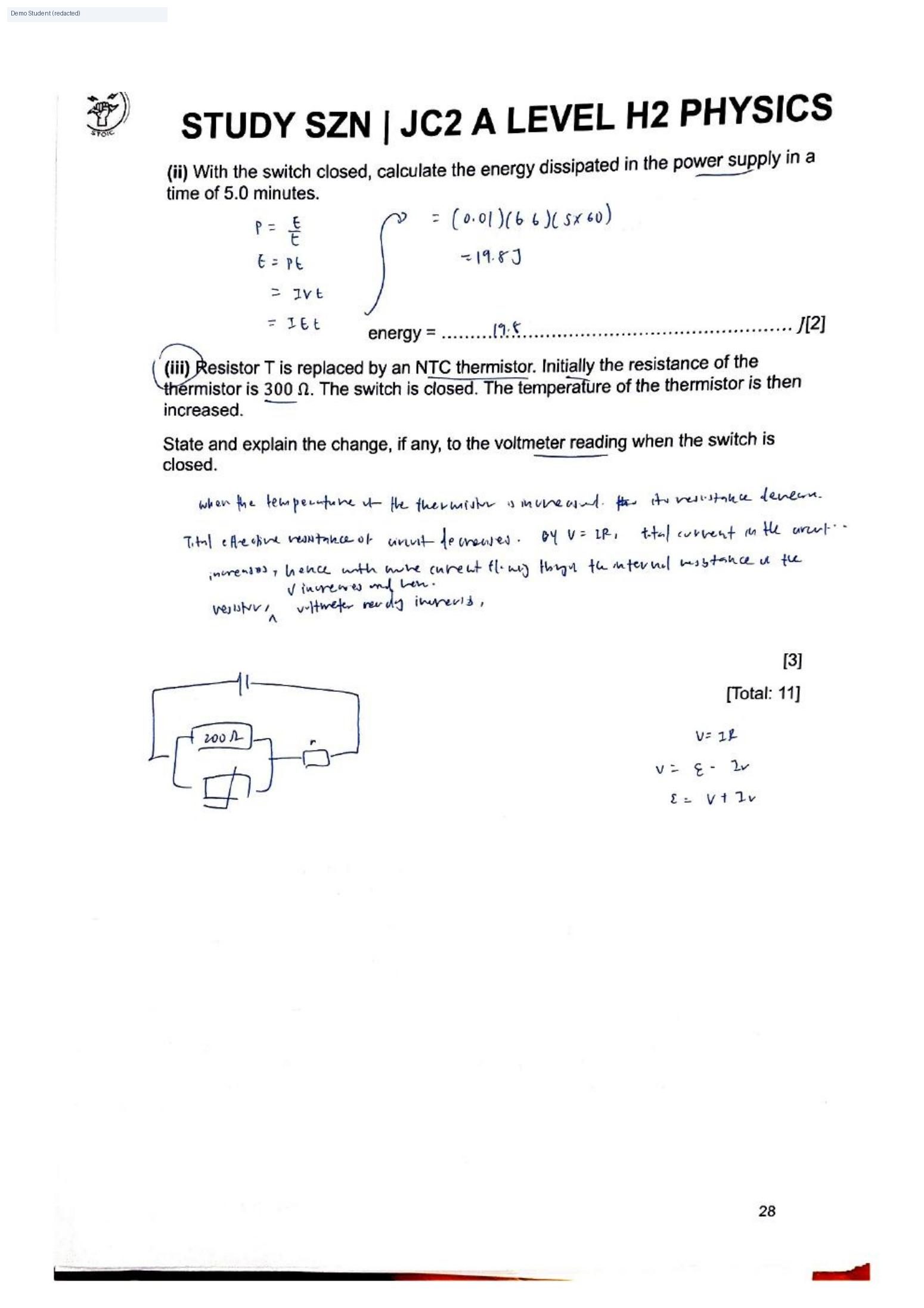
Q5(b)(ii) current
Current through r when closed is about 0.090 A (for example 10.8/120), not 0.01 A.
0.01
What to do next: I = E/(R+r) or I = V/R with the correct E and r.
Q5(b)(ii) energy
is wrong. Energy dissipated in the internal resistance is (about with correct values).
19.8 J
What to do next: Use I^2 r t with I about 0.090 A, r about 13.3 ohm, t = 300 s.
Q5(b)(iii) NTC
Correct. An NTC thermistor's resistance falls as temperature rises.
resistance decrease
Q5(b)(iii) current up
Correct. Total current increases when total resistance falls.
total current ... increases
Q5(b)(iii) V falls
The terminal pd falls, not rises. Larger current means a larger Ir drop, so V = E - Ir decreases.
voltmeter reading increases
What to do next: End with: voltmeter reading decreases.
No comments on this page.
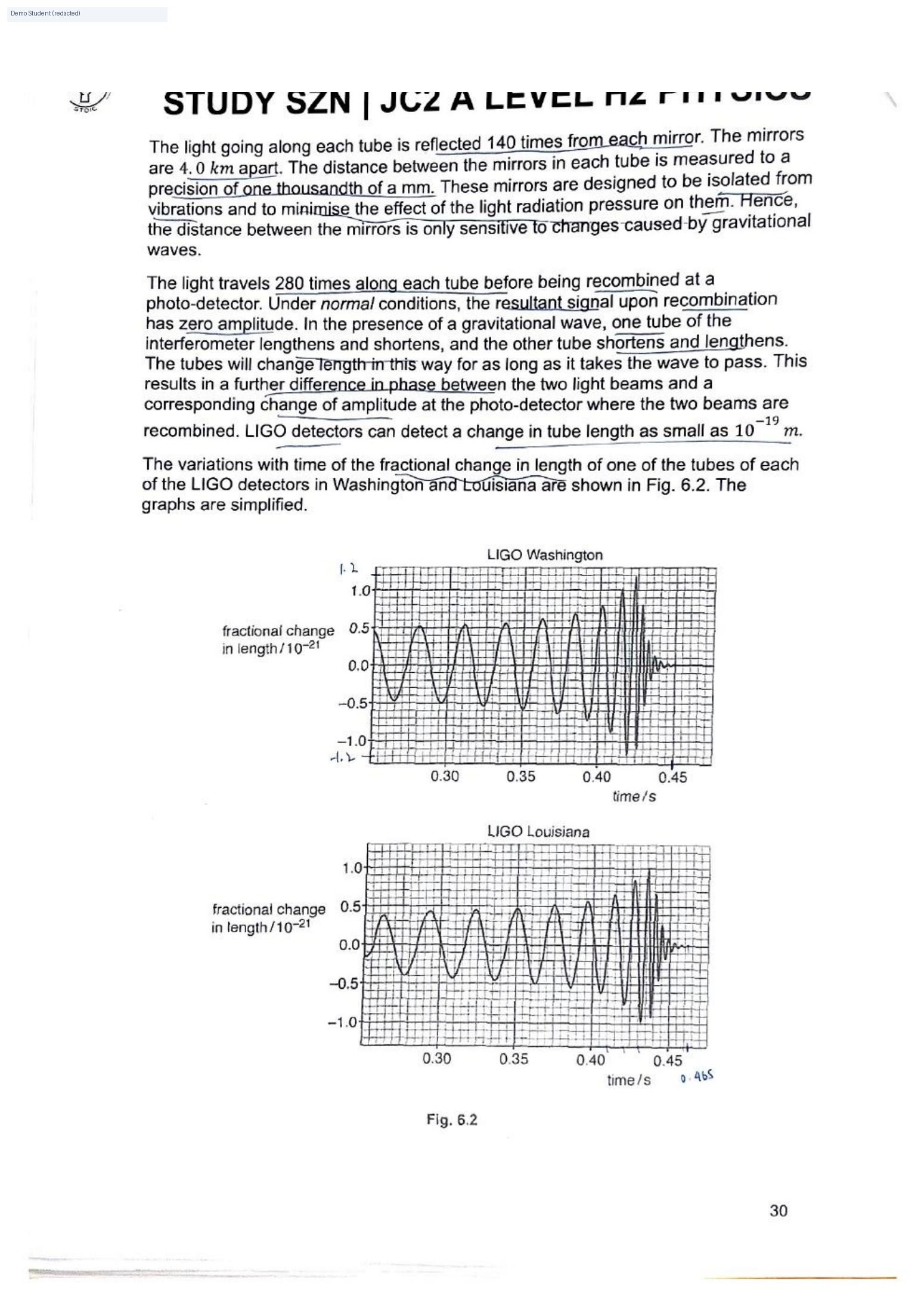
No comments on this page.
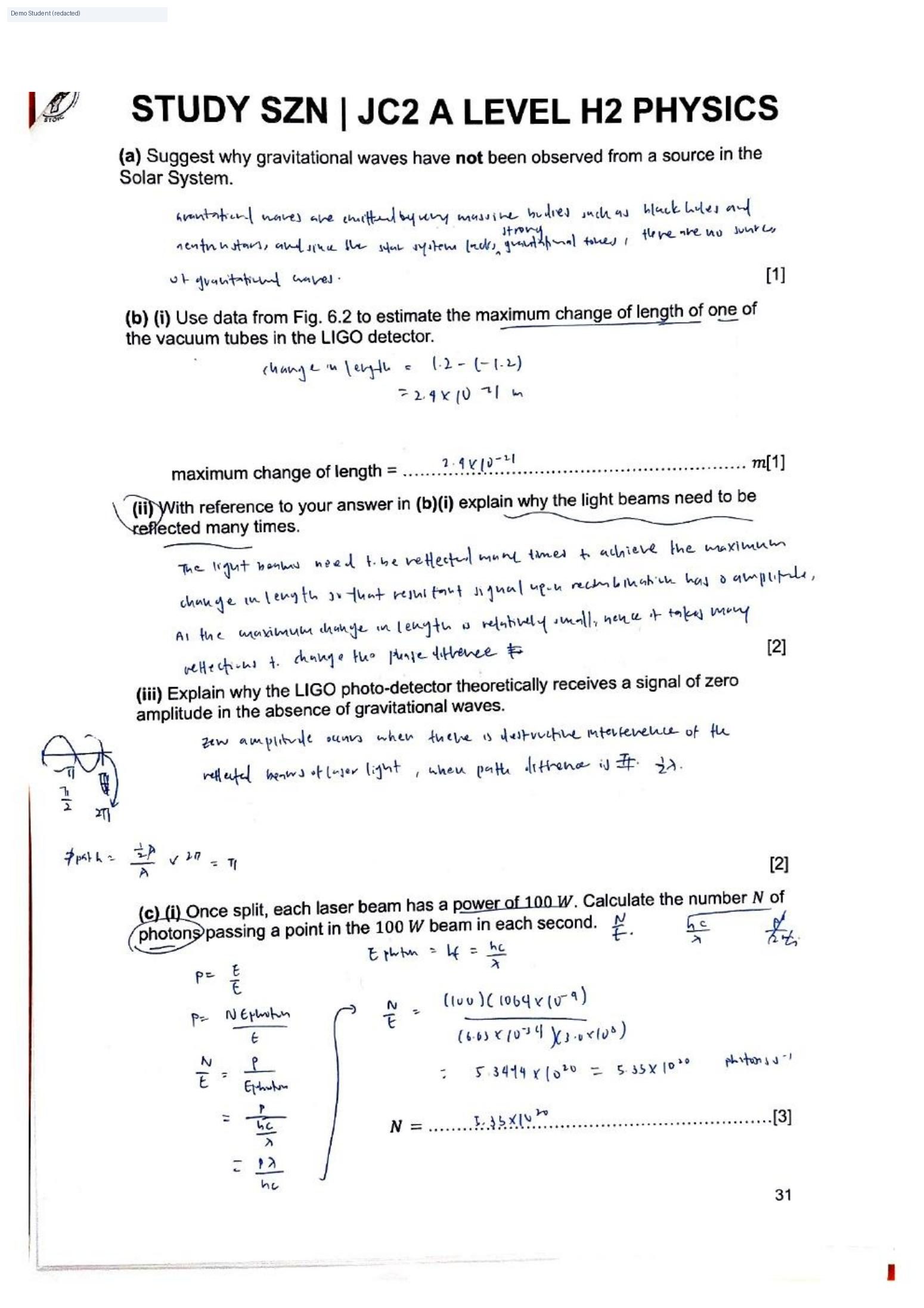
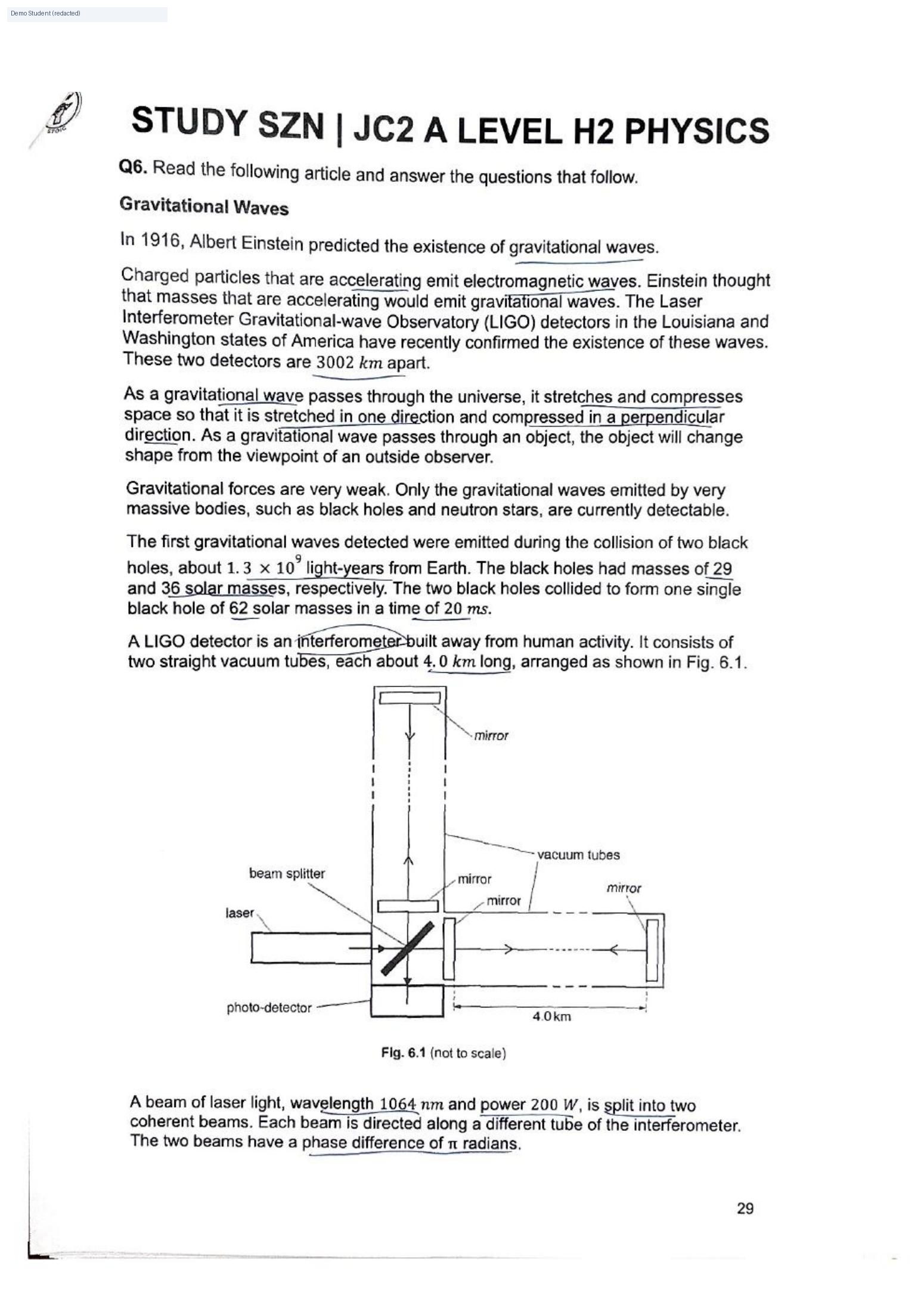
Q6(a) masses
Correct idea: Solar System sources are not massive enough compared with merging black holes.
solar system lacks strong gravitational sources
Q6(b)(i) dL
You used the fractional change alone. Multiply by the tube length 4.0 km: is about .
What to do next:
Q6(b)(ii) too small
Correct. The length change is far too small compared with a wavelength-scale path difference.
relatively small
Q6(b)(ii) reflections
Correct idea: many reflections build up a usable path / phase difference.
many reflections to change the phase difference
Q6(b)(iii) zero amp
Also say the two beams have equal amplitude, so complete destructive interference gives zero resultant amplitude.
destructive interference ... zero amplitude
What to do next: Equal amplitude + antiphase => resultant amplitude zero.
Q6(b)(iii) antiphase
With no gravitational wave the path lengths are equal, and the beams meet with phase difference pi (antiphase), not path difference pi/2.
path difference is ,
What to do next:
Q6(c)(i) photon energy
Correct. Photon energy E = hc/lambda.
Q6(c)(i) value
Correct. N = s^-1.
Q6(c)(i) N from P
Correct. per second .
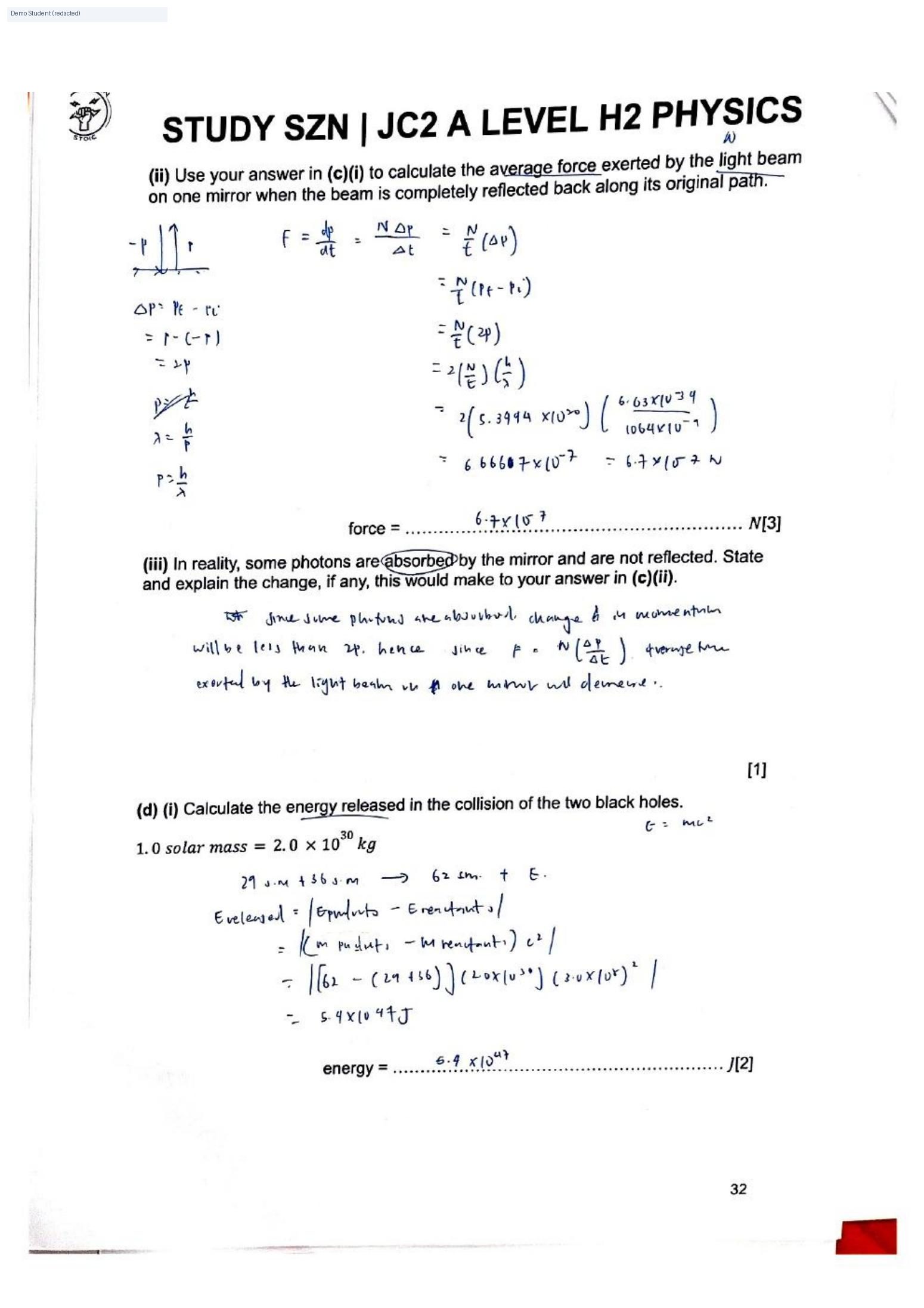
Q6(c)(ii) dp=2p
Correct. On reflection, change in momentum is 2p.
2p
Q6(c)(ii) momentum
Correct. Photon momentum p = h/lambda.
Q6(c)(ii) force
Correct. Average force about N.
Q6(c)(iii) absorbed
Correct. Absorbed photons give a smaller momentum change, so the average force decreases.
force ... will decrease
Q6(d)(i) mass defect
Correct. Mass defect is 3 solar masses.
Q6(d)(i) energy
Correct. Energy released = J.
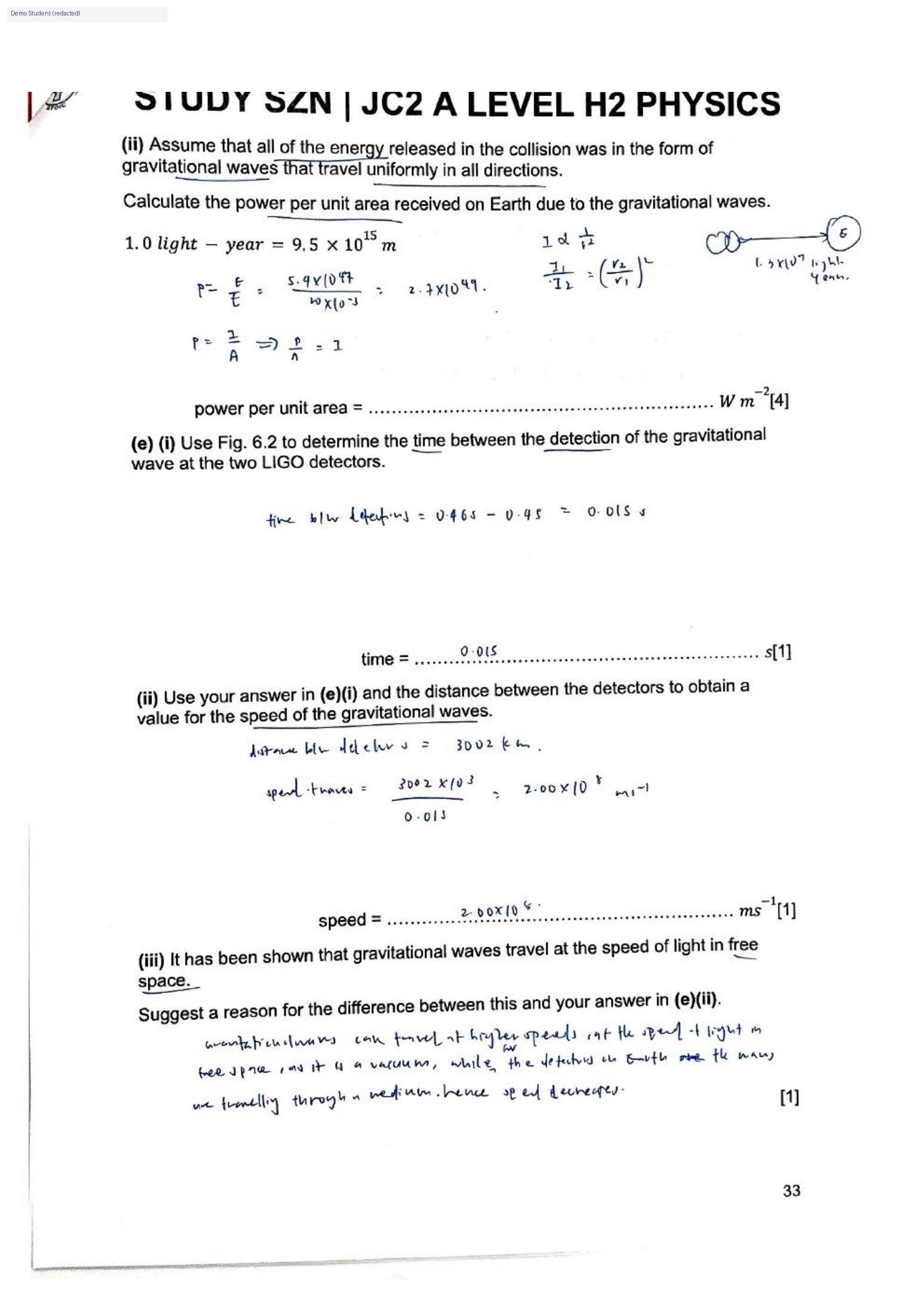
Q6(d)(ii) point source
Correct idea: treat the source as a point and use the inverse-square law.
Q6(d)(ii) power
Correct. Power = E/t = W.
Q6(d)(ii) intensity formula
Write with in metres.
What to do next:
Q6(d)(ii) blank I
No final intensity. With the correct steps, is about .
blank
What to do next:
Q6(e)(i) time
0.015 s does not match the chirp peaks well. Read the time between the two largest peaks on Fig 6.2 (about 0.007 to 0.012 s).
0.015
What to do next: Compare the Washington and Louisiana peak times carefully.
Q6(e)(ii) speed method
Correct method: using your time interval.
What to do next: With a better delta t near 0.01 s you get a speed closer to c.
Q6(e)(iii) path
The issue is not a medium slowing the wave. Gravity bends / lengthens the actual path compared with the straight surface distance.
travelling through a medium
What to do next: Say the true path is longer because of gravitational fields of Earth and the Solar System.
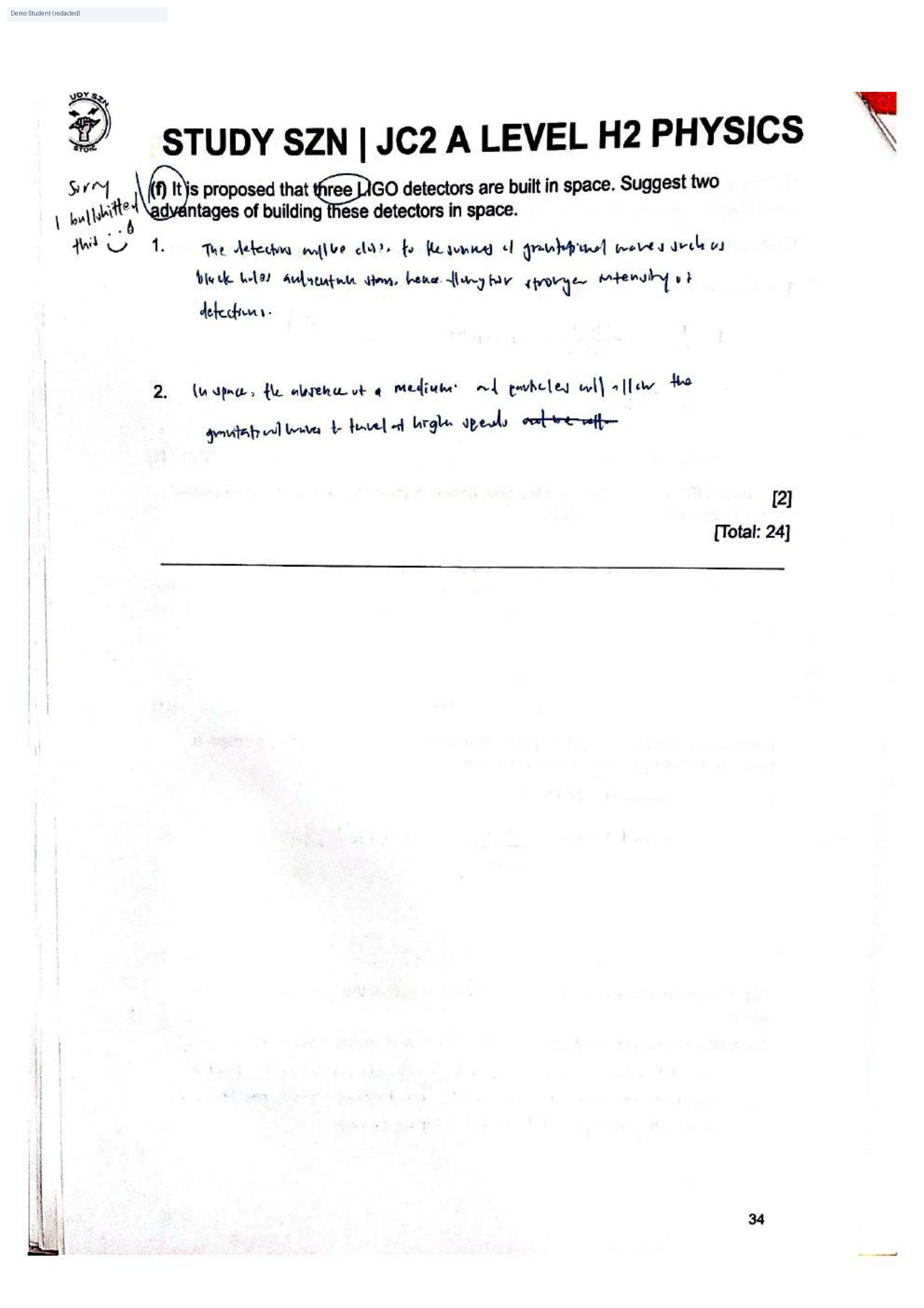
Q6(f) advantage 1
Being closer to sources is not a valid advantage here. Better points: much less vibration from human activity, easier vacuum, or less dust in the beam path.
closer to the sources
What to do next: Pick two from: less vibration, easier vacuum without pumps, less dust.
Q6(f) advantage 2
Gravitational waves do not need a higher speed in space for this mark. Use a scheme advantage such as reduced vibration or easier vacuum.
absence of a medium ... higher speeds
What to do next: Replace with reduced seismic noise or vacuum quality.
Q1(a) net force
Correct. You stated that there is no net force acting on the body.
no net force acting on the body